
Board sock / lightweight cover
- Main role
- Surface coverage against light abrasion, scratches and contact.
- Bulk
- Low, because the construction is thin or flexible.
- Best fit when
- Handling is light and impact cushioning is not the main requirement.
Choose a surfboard bag or cover by matching the board's actual length, maximum width, thickness and outline to the bag's usable fit, then match the enclosure type and construction to the expected handling conditions. Do not choose by labelled length alone: a bag can fit the board yet still be the wrong choice for travel if its padding, reinforcement or capacity does not match the handling conditions.
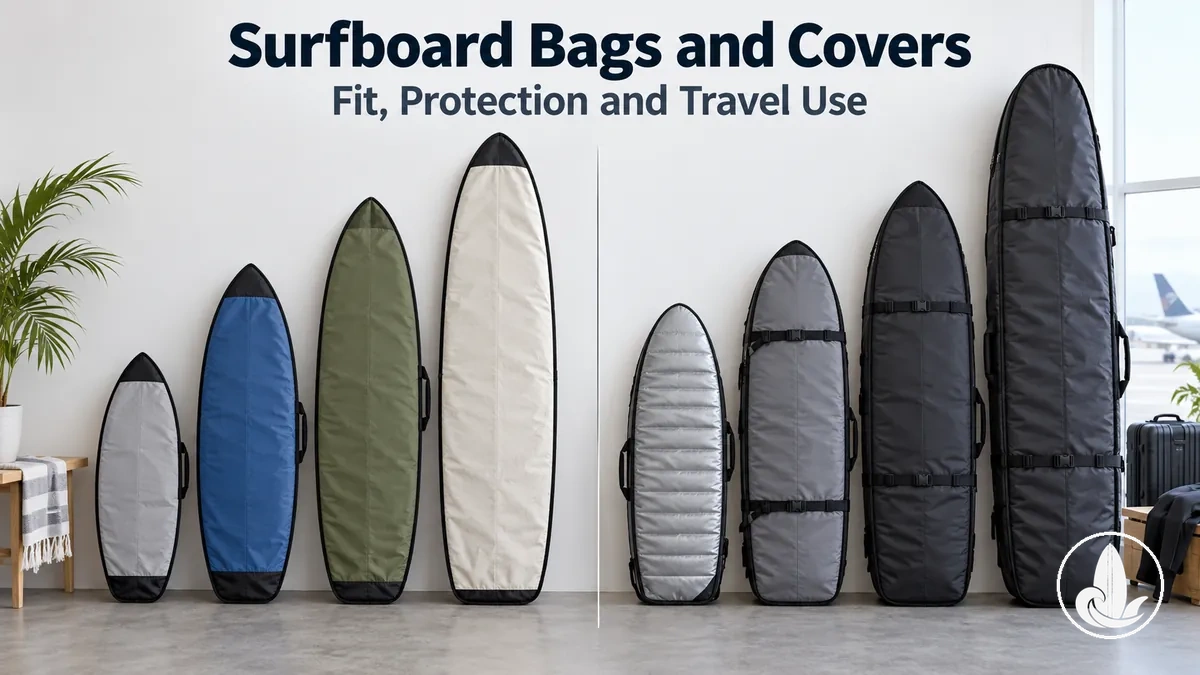
Surfboard bag decision guide
Use the same decision order for any bag or cover: confirm fit first, choose the protection profile second, then verify the construction details that support that use.
Exact fit and protection remain model-specific. Use the manufacturer's usable dimensions and fit guidance where available rather than assuming that one nominal size or one padding specification works for every board.
A useful selection sequence is therefore fit → handling demand → protective construction. The sections below separate those decisions so the bag type, clearance and protection features can be checked without treating any one label or feature as a guarantee.
Surfboard bag and cover type describes the enclosure's protective role more usefully than a marketing label alone. The main distinctions are padding, structure, carrying bulk, capacity and the handling conditions the enclosure is intended to face.
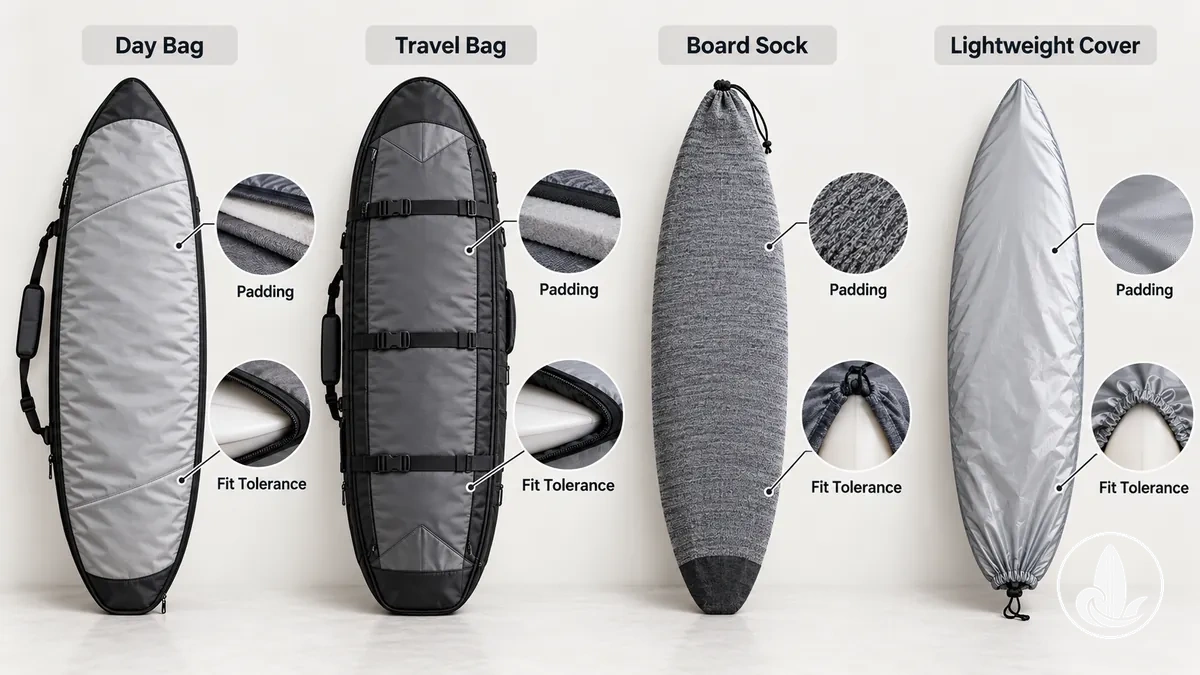
Board sock / lightweight cover
Day bag
Travel bag
The same surfboard can therefore call for a different enclosure when the handling context changes. Whatever the type, the board still has to fit the specific bag's dimensions, profile, closure and usable internal space.
A day bag is typically a lightweight padded bag for routine use, while a travel bag generally uses more substantial padding, reinforcement or capacity for higher-stress transit; exact construction varies by model.
Compare them on the same attributes—use, padding, reinforcement, capacity, bulk and handling demand—rather than assuming that the word “travel” establishes a fixed protection level.
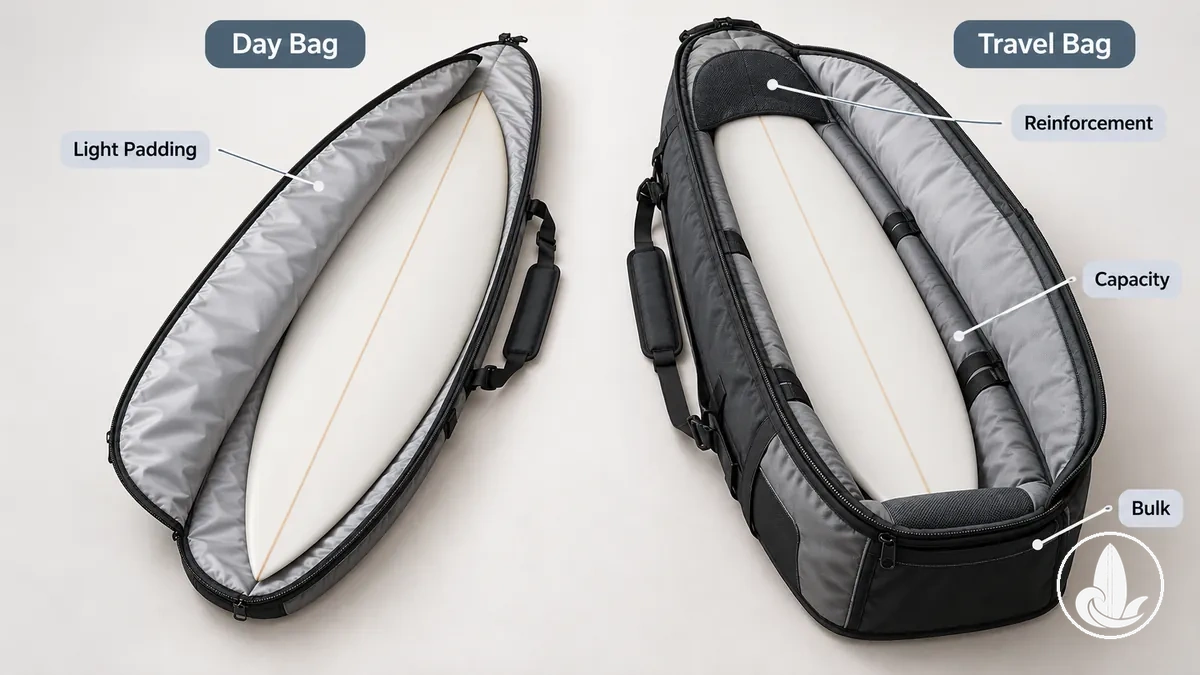
| Attribute | Day Bag | Travel Bag | Decision Effect |
|---|---|---|---|
| Typical use | Daily use and routine handling | Transit and higher-stress handling | Match the bag type to the handling conditions the board is expected to encounter. |
| Padding | Light padded construction | Typically thicker or more substantial padded construction | Greater padding can provide more impact buffering, with the actual level determined by the individual bag's construction. |
| Reinforcement | Routine protective structure | Typically greater reinforcement at vulnerable or load-bearing areas | Additional reinforcement becomes more relevant as handling intensity increases. |
| Capacity | Commonly oriented toward a single board | Available in single-board and multi-board configurations | The required number of boards determines the capacity that must be accommodated. |
| Bulk | Lightweight, less bulky construction | Typically bulkier because of additional padding, reinforcement or capacity | More protective structure or capacity generally increases carrying bulk. |
| Handling demand | Routine local carrying and daily handling | More demanding transit conditions | Higher handling intensity increases the relevance of padding and reinforcement. |
The main trade-off is carrying bulk versus protective construction. A day bag can suit routine handling where low bulk matters, while a travel bag becomes more relevant as transit demands, board count or the need for reinforced construction increase.
Additional travel-bag construction does not eliminate handling risk; the bag still has to fit correctly and its specific padding and reinforcement must correspond to the conditions the board will encounter.
A padded bag adds a cushioning layer between the surfboard and external contact, while a board sock or lightweight cover mainly provides a lighter barrier against abrasion, scratches and surface exposure.
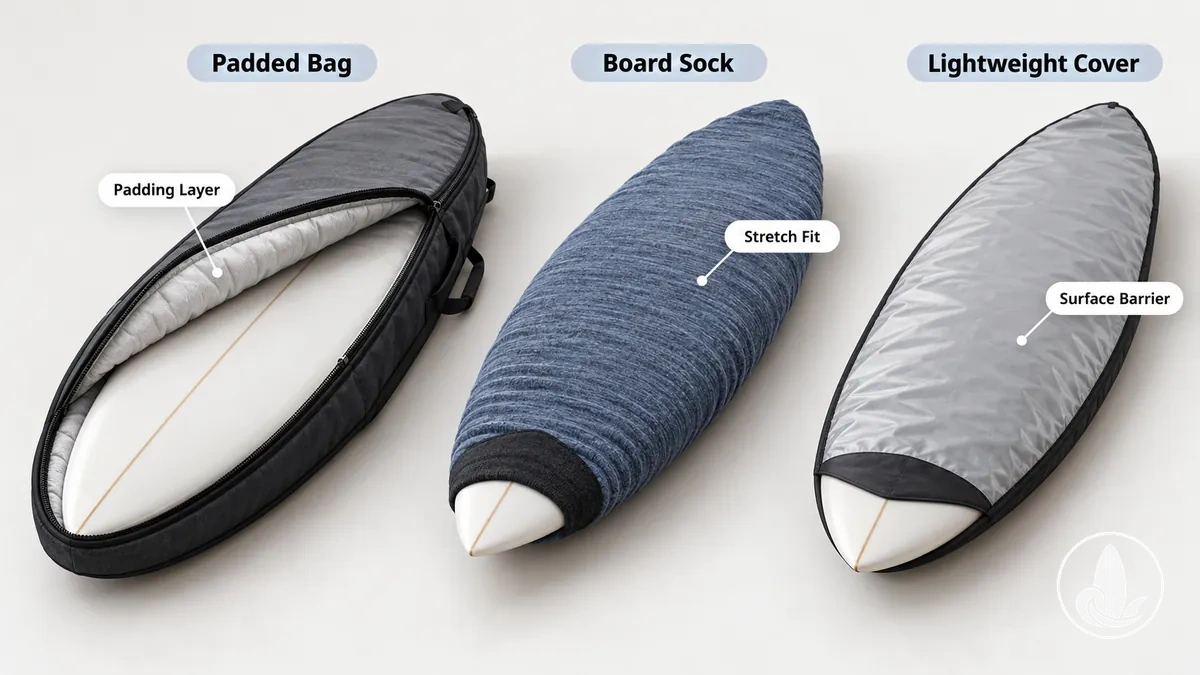
| Attribute | Padded Bag | Board Sock / Lightweight Cover | Decision Effect |
|---|---|---|---|
| Impact buffering | Padding creates a cushioning layer between the surfboard and external contact. | Lightweight fabric provides less impact buffering than a padded enclosure. | A padded bag is the stronger construction choice when the handling context includes knocks or impacts. |
| Scratch / abrasion barrier | Fabric and padding separate the board surface from surrounding surfaces. | Lightweight fabric provides a surface barrier against light abrasion and scratches. | Lightweight coverage can suit limited handling where surface contact is the primary concern. |
| Fit tolerance | Internal dimensions, board shape and closure design determine the available fit tolerance. | A board sock can use flexible or stretch construction that follows the board shape closely, while lightweight-cover fit depends on its material and construction. | The enclosure must accommodate the board shape without assuming that every flexible cover has the same fit behavior. |
| Bulk | Padding and structured construction create greater carrying bulk. | Thin, flexible construction creates less carrying bulk. | Lower bulk favours lightweight coverage when substantial impact buffering is not required. |
| Typical handling context | Handling where added cushioning against contact or impacts is useful. | Light handling where surface coverage against scratches and abrasion is the main requirement. | Match the enclosure construction to the expected type and intensity of handling. |
Choose lightweight coverage when surface contact is the main concern and low bulk matters. Choose padded construction when knocks or impacts are more plausible, while recognising that impact buffering still depends on the padding, materials, fit and construction of the individual bag.
Storage is a separate condition: neither lightweight fabric nor padding alone makes an enclosure suitable for every storage environment, so ventilation, moisture exposure and the specific material should be considered separately from impact protection.
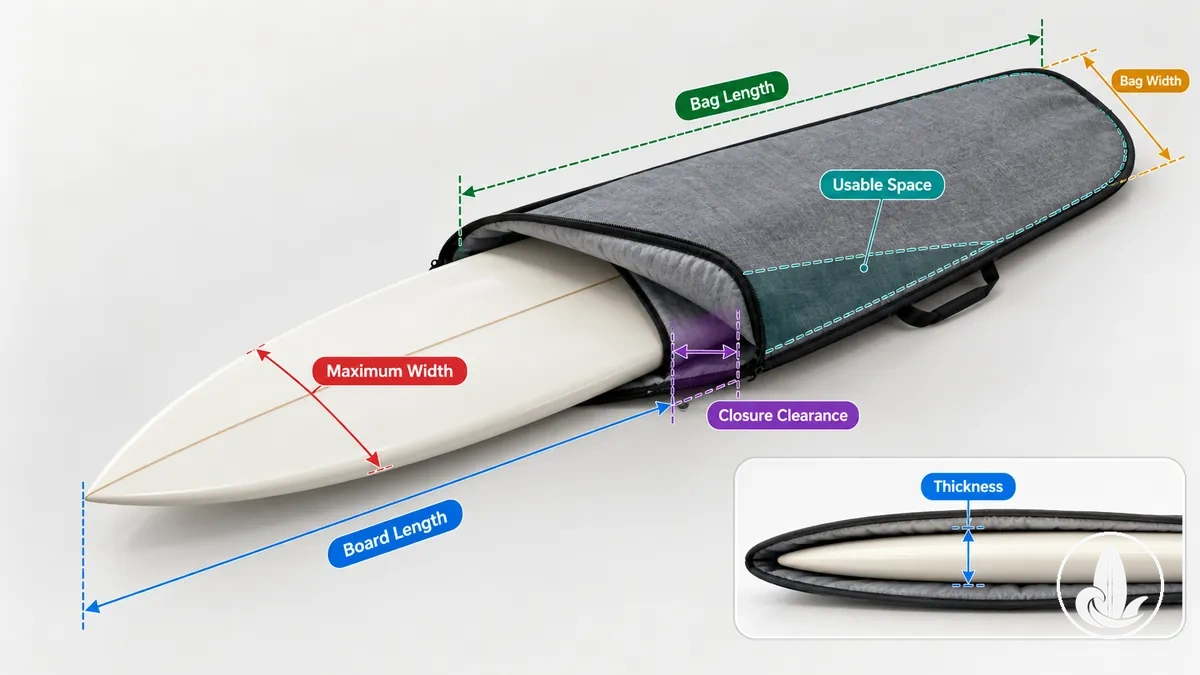
Surfboard bag fit is the relationship between the board's dimensions and shape and the bag's usable internal space when the enclosure can close as intended. Length is necessary, but it is not sufficient: maximum width, thickness/profile and outline can prevent a board from fitting even when the nominal length looks correct.
Padding, the fin setup and multiple-board loading can also consume internal space, so compare the board with usable dimensions or manufacturer fit guidance rather than relying on the size label alone.
Fit modifiers after the core dimensions
Two bags with the same labelled length can therefore fit differently. Where available, manufacturer fit guidance and usable dimensions are the most relevant reference for the specific bag design.
Match the board length to the usable bag length, the maximum width to the bag width at the corresponding area, the thickness to the available internal depth, and the outline to the bag profile or cut.
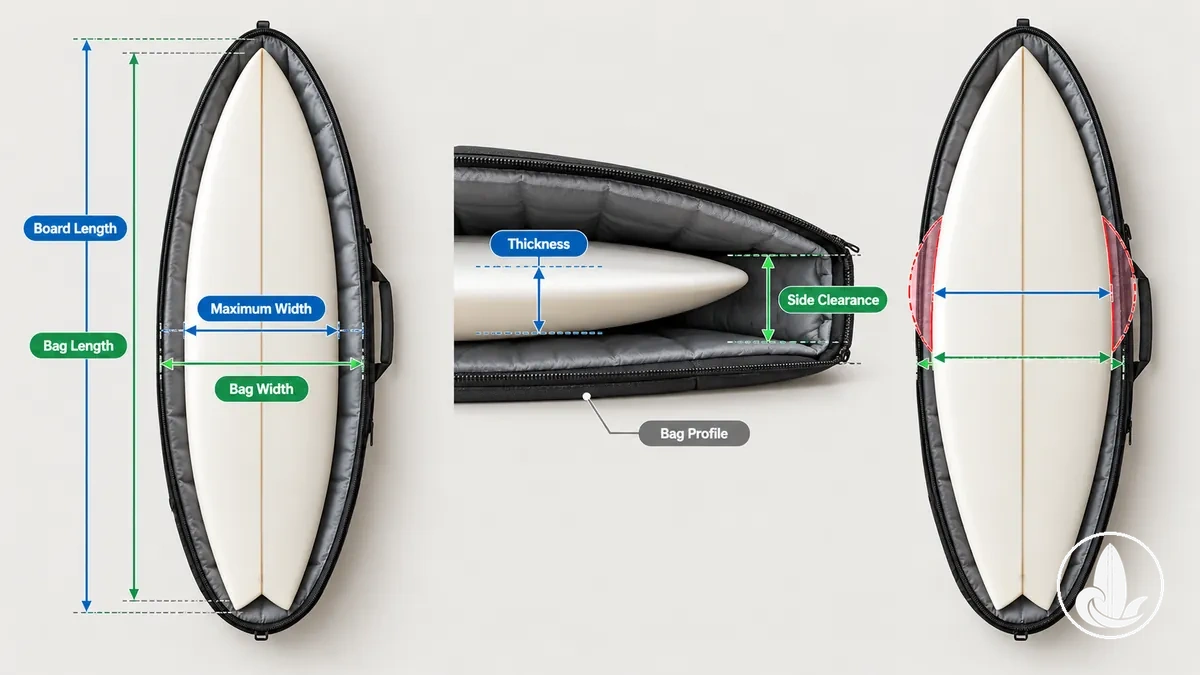
Matching length does not guarantee overall fit. For example, a wide board may have enough nose-to-tail clearance yet still exceed the bag's usable width around its widest point.
A surfboard bag needs enough extra room for the board and padding to sit inside without obstructing the closure, but not so much room that the board can move substantially inside the enclosure. There is no universal extra-length allowance because usable clearance changes with bag type, padding, board shape and closure design.
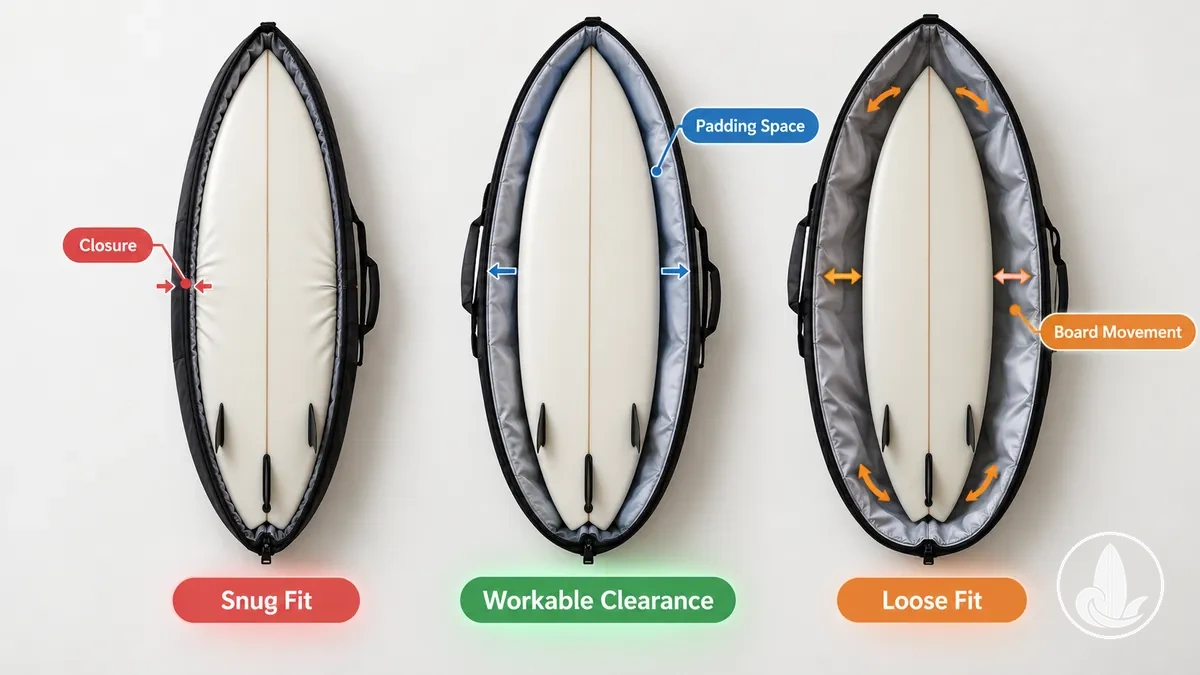
Too little clearance
The closure is difficult to operate, the board forces the bag profile, or the available padding space is excessively compressed.
Workable clearance
The board sits within the bag profile, the closure works as intended, padding retains usable space, and unnecessary internal movement is limited.
Excessive clearance
The board has enough unused internal space to shift substantially, reducing the control provided by the fit.
Published size allowances vary by design and manufacturer, so a single inch or centimetre figure should not be normalised into a universal rule. Judge clearance by the specific board-to-bag relationship and the manufacturer's stated fit guidance where available.
A surfboard bag's protection comes from the combined effect of padding coverage and construction, not from padding thickness alone. As handling becomes more demanding, the location, continuity and construction of protective features become more consequential.
Protective needs rise with handling stress, but a soft surfboard bag cannot guarantee damage prevention. Evaluate each feature by the contact, movement or handling condition it is intended to address.
Surfboard-bag padding should be assessed through padding thickness, padding density and padding coverage together, because they influence the amount, compression behaviour and location of cushioning material.
No single millimetre thickness is sufficient for every bag or handling condition. The more useful comparison is how cushioning is distributed across the main panels, rails, nose and tail, and how that construction balances protection with carrying bulk.
| Padding Attribute | Coverage Area | What It Can Help With | Trade-off / Condition |
|---|---|---|---|
| Padding thickness | Areas containing foam padding | Provides cushioning material between the board and external contact. | Greater thickness adds material bulk, while impact buffering also depends on padding density, foam characteristics and construction. |
| Padding density | Padded areas of the bag | Influences how the cushioning material responds under compression. | Its contribution to impact buffering depends on thickness, foam characteristics, construction and the handling condition. |
| Main-panel coverage | Main panels over the broad faces of the board | Places cushioning across larger surface areas of the enclosed board. | The functional effect depends on the padding characteristics and the contact or handling conditions affecting those areas. |
| Rail reinforcement | Rails | Concentrates reinforced padding along the board's side edges where that coverage is built into the bag. | Additional material increases bulk, while the resulting impact buffering remains conditional on the padding and construction. |
| Nose reinforcement | Nose | Concentrates padding coverage around the nose where the bag design includes reinforcement. | The resulting impact buffering depends on the padding characteristics, construction and handling condition. |
| Tail reinforcement | Tail | Concentrates padding coverage around the tail where the bag design includes reinforcement. | The resulting impact buffering depends on the padding characteristics, construction and handling condition. |
Main-panel padding gives broad coverage, while reinforced rails, nose or tail concentrate material at specific zones. The practical effect still depends on foam characteristics, construction and the type of handling or contact involved.
More material also increases bulk, so greater thickness or reinforcement in one area should not be treated as automatic proof of better overall protection.
Non-padding construction features matter when they change containment, board separation, abrasion exposure or coverage of vulnerable areas. Their value comes from the condition they address, not from the feature name by itself.
Shoulder straps, pockets and similar convenience features are secondary unless they materially change how the bag or board is handled. Likewise, material names and marketing terms alone do not establish a fixed level of durability or damage prevention.
Evaluate the complete bag as a system: fit keeps the board controlled, padding adds cushioning, and construction maintains coverage and containment under the intended handling conditions.